Archaeologists Find
Archaeologists Find Massive New Piece of Stonehenge Puzzle
By Jan Wesner Childs
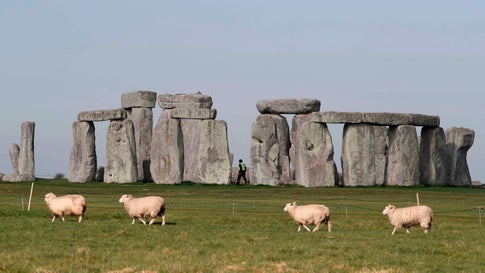
Archaeologists surveying an area near England's famous Stonehenge have found what could be one of the largest prehistoric sites known to exist in the country.
The discovery consists of 20 underground pits built in a 1.2-mile-wide circle, according to a news release from Bradford University. Each is a deep, wide shaft measuring up to 15 feet down and 30 feet across. The series of pits form a ring around Durrington Walls, the site of a large Neolithic settlement that is part of the Stonehenge World Heritage Site.
Researchers at the site first thought they were ponds or natural sinkholes, but thermal imaging was able to reveal more details. They've also found carbon-dated artifacts in the pits that date back about 4,500 years.
He called them a pattern on "a massive scale."

The findings were recently published in the journal Internet Archaeology.
Stonehenge and its stone circles are a World Heritage Site and, along with other adjacent locations, is the most famous prehistoric monument in the world, and widely considered to be the most important.
Like Stonehenge itself, no one knows for sure why the pits were dug or what their significance was. But they do know that Durrington Walls was a settlement for the builders of Stonehenge.
Researchers estimate there may have originally been more than 30 pits, and say their size is another example of the complexity of structures within Stonehenge.
“The Stonehenge landscape stands apart, not only as one of the most important archaeological landscapes in the world, but also amongst the best studied," said Eamonn Baldwin, a researcher from the University of Birmingham who worked on the project. "To make such a major discovery within such an area is remarkable, and testament to how archaeologists have begun to integrate technology with traditional research methods, including excavation and aerial photographic survey.”
Ketchup
Well, think about it for a mere moment. Ketchup's main ingredient is the tomato. The tomato is a fruit. So, with that logic:Discordian Calendar
The Discordian Calendar
Many dates on this
site are given according to the unholy Discordian calendar. If you don't know
what "Discordian" means, you should read the Principia Discordia. You should probably
read it anyway, if you haven't done so already.
The calendar is
divided into five (of course!) seasons:
Name
Patron apostle
Chaos
Hung Mung
Discord
Dr. Van Van Mojo
Confusion
Sri Syadasti
Bureaucracy
Zarathud
The Aftermath
The Elder Malaclypse
The days of the week are named from
the (guess what!) five Basic Elements: sweet, boom, pungent, prickle and
orange:
- Sweetmorn
- Boomtime
- Pungenday
- Prickle-Prickle
- Setting
Orange
Holydays
Apostle Holydays
Season Holydays
1) Mungday
1) Chaoflux
2) Mojoday
2) Discoflux
3) Syaday
3) Confuflux
4) Zaraday
4) Bureflux
5) Maladay
5) Afflux
Apostle Holydays occurs on the 5th
day of the Season.
Season Holydays occurs on the 50th
day the Season.
St. Tib's Day occurs once every 4
years (1+4=5, of course) and is inserted between the 59th and 60th days of the
Season of Chaos.
|
Name
|
Patron apostle
|
|
Chaos
|
Hung Mung
|
|
Discord
|
Dr. Van Van Mojo
|
|
Confusion
|
Sri Syadasti
|
|
Bureaucracy
|
Zarathud
|
|
The Aftermath
|
The Elder Malaclypse
|
|
Apostle Holydays
|
Season Holydays
|
|
1) Mungday
|
1) Chaoflux
|
|
2) Mojoday
|
2) Discoflux
|
|
3) Syaday
|
3) Confuflux
|
|
4) Zaraday
|
4) Bureflux
|
|
5) Maladay
|
5) Afflux
|
Become a Pope

Imposition of Order = Escalation of Chaos
The Discordian Hot Dog
H0T D09S
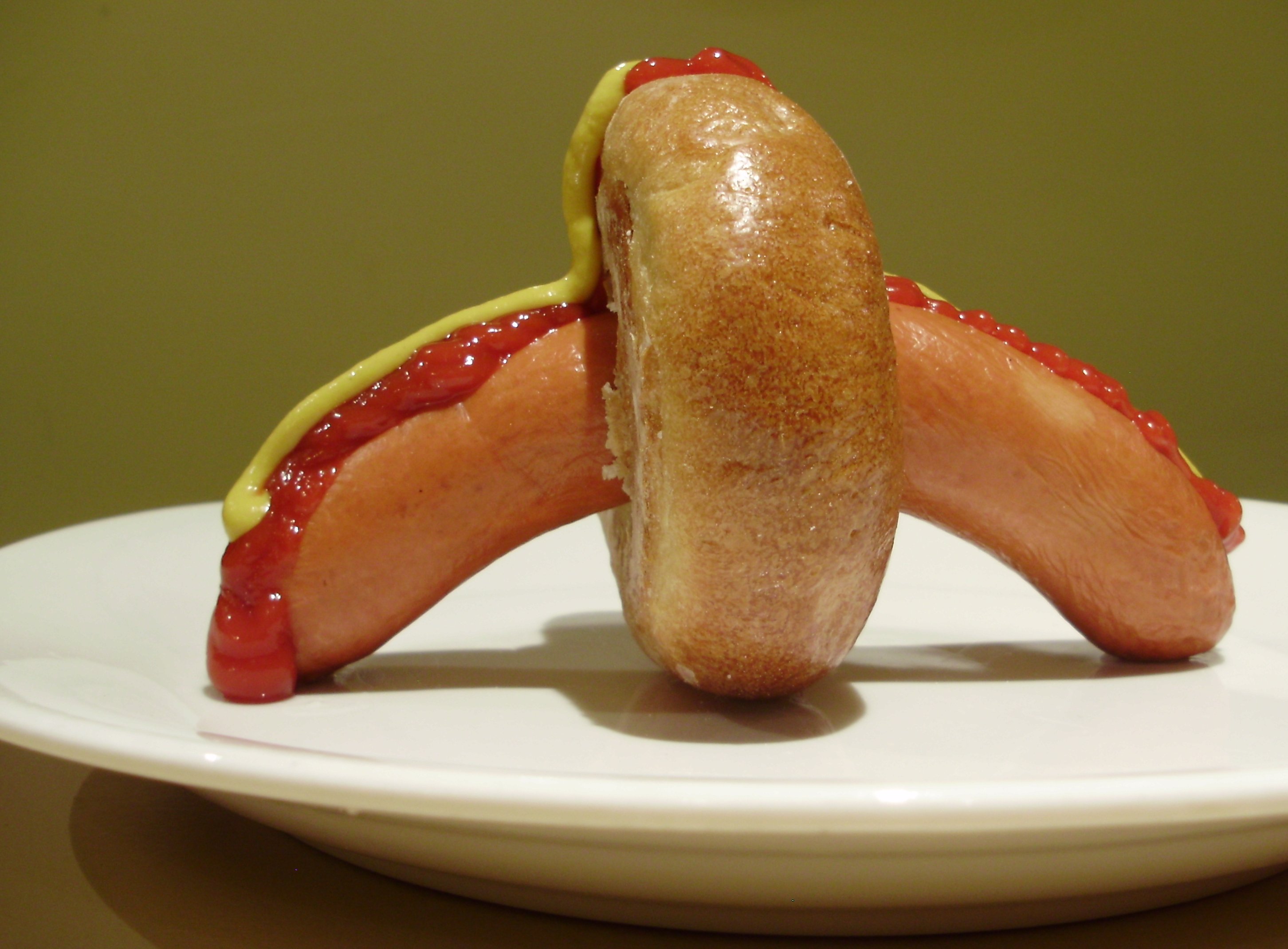
consumption of hot dog buns. This dates back to at least the Fifth Year of The
Caterpillar when the hermit Apostle Zarathud first found the FIVE
COMMANDMENTS carved in gilded stone while building a sun deck for his cave.
The exact wording of the pertinent commandment is:
A Discordian shall Partake of No Hot Dog Buns, for Such was the Solace of Our
Goddess when She was Confronted with The Original Snub.
— Commandment IV of the PENTABARF
have found the perfect solution: all you need do is put the frankfurt through a
bagel.
Complete Art of Collecting Belly-button Lint

II
I collect belly-button lint!
Now that I have undoubtedly sold you completely on the art of collecting belly-button lints, your first reaction is probably: where would an ordinary person like yourself obtain old and rare lints? However, I think I should warn you about using lints for practical purposes instead of keeping them. Nothing, I repeat, nothing beats the grandeur of collecting–especially collecting such an important item as belly-button lint. What could be more satisfying than surprising your house guests by showing them a mounted board or row of glass cases containing hundreds of lints! Doesn’t it sound wonderful!!! It is almost a sure bet that they will never bother you again.
Chaos Magic in a Nutshell
Chaos Magic in a Nutshell 

Wicca
What is Wicca?

Wicca has no central authority figure. Its traditional core beliefs, principles and practices were originally outlined in the 1940s and 1950s by Gardner and Doreen Valiente, both in published books and in secret written and oral teachings passed along to their initiates. There are many variations on the core structure, and the religion grows and evolves over time. It is divided into a number of diverse lineages, sects and denominations, referred to as Traditions. Each Tradition follows its own organizational structure. Due to its decentralized nature, there is some disagreement over what actually constitutes Wicca. Some traditions, collectively referred to as British Traditional Wicca, strictly follow the initiatory lineage of Gardner and consider the term Wicca to apply only to similar traditions, but not to newer, eclectic traditions.
Wicca is typically duotheistic, worshipping both a Goddess and a God. These are traditionally viewed as the Moon Goddess and the Horned God, respectively. These deities may be regarded in a henotheistic way, as having many different divine aspects which can, in turn, be identified with many diverse pagan deities from different historical pantheons. For this reason, they are sometimes referred to as the “Great Goddess” and the “Great Horned God”, with the adjective “great” connoting a deity that contains many other deities within their own nature. These two deities are sometimes viewed as facets of a greater divinity, which is regarded as an impersonal force or process rather than a personal deity. While duotheism is traditional in Wicca, broader Wiccan beliefs range from polytheism to pantheism or monism, even to Goddess monotheism.
Wiccan celebrations encompass both the cycles of the Moon, known as Esbats and commonly associated with the Goddess and the cycles of the Sun, seasonally based festivals known as Sabbats and commonly associated with the Horned God. An unattributed statement known as the Wiccan Rede is a popular expression of Wiccan morality, although it is not universally accepted by Wiccans. Wicca often involves the ritual practice of magic, though it is not always necessary.The Faery Tradition
The Faery Tradition
Faery is a modern form of American Traditional Witchcraft
derived from the teachings of Victor and Cora Anderson. These were passed down
through their other initiates, still thriving even today. A rich and diverse
spiritual art, Feri seeks to transform the individual through practices of
ritual magic, meditation, and energy work. Faery draws power from various
cultures and their magical systems including Huna; Conjure; Voodoo; Tantra;
Celtic Folklore; Christian Mysticism; Yezidi Mythology; Greek Gnosis; and
others, and continues to integrate the magic and mysteries of ancient and
evolving cultures into its rich spiritual tapestry. Image result for faery
tradition Faerie is understood and integrated through direct experience;
adherents include dedicated practitioners and persons initiated ritually into
its mysteries. The diversity of the Tradition can be seen in the various
spellings of the name, which include Faery, Faerie, Fairy, and Feri.Celtic Paganism
Ancient Celtic religion comprised the beliefs and practices of peoples of Western Europe now known as the Celts. The time mostly associated with Celtic society was roughly between 500 BC and 500 AD, spanning the many different periods in ancient times: the Roman, British, and Irish Iron Age societies being only three of the best known.
Very little is actually known with any certainty about the Celtic people for they did not leave written records; most all knowledge was passed down verbally, from generation to generation, and apart from documented names that are thought to be of deities, the only detailed accounts were done by the Roman invaders.

Celtic paganism was one of a larger group of Iron Age polytheistic religions. The Celtic pantheon consists of numerous recorded deities, both from Greco-Roman stories and written literature. Figures from medieval Irish mythology have also been interpreted as iterations of earlier deities as well.
According to Greek and Roman accounts, the Druids came to be in Gaul, Britain, and Ireland. Very little is definitely known about them. Following the conquest of Gaul and southern Britannia, though, Celtic religious practices began to display elements of the new Romanization, resulting in a Gaelic-Roman culture with its own religious traditions, and thus, its own set of gods and goddesses, such as Cernunnos, Artio, Telephones, etc.
In Roman Britain, this lost at least some ground to Christianity by the time the Romans left in 410. This began to change in the next century as the pagan Anglo-Saxon religion was in the process of getting eradicated. Christianity was supplanting the earlier religious traditions; however, polytheistic traditions still left a legacy in many of the Celtic nations, and eventually served as the basis for a new religious movement: Celtic Neopaganism, in the 20th century.
![]() |
| Celtic Fairy Tales Download |
Paganism
Sacred places are recognized either as a personified natural feature like a mountain or lake, or as a fully articulated guardian spirit, entity, or deity such as Athena, the goddess of Athens or Poseidon, the God of the Oceans. The cycle of the natural year is seen by most Pagans as a model of spiritual growth and renewal. This is most commonly known as the Wheel of the Year. The Wheel’s eight spokes are marked by festivals according to the seasons. The earth is sacred; the Wheel marks the movement of the earth through the seasons.
Each culture had its own set of beliefs and their own set of gods and goddesses. Also, the number of gods and goddesses within each culture were considerable. The funny thing about all this is that the gods and goddesses were recognized as being the same between cultures; only the names changed. The Goddess of Love was known as Venus in Rome but was called Aphrodite in Greece. Similarly, the God of Magick in Greece was Hermes; he was known as Thoth in Egypt. All Pagan religion was not public religion; much of it was domestic. This was religion that pervaded the whole of everyday life. Followers lived, breathed, and died revering the earth and their Gods. This was not a religion where you could put on a suit or dress on a Sunday morning and just give an hour of your time away. This was living Life. Magic was an acceptable activity in Pagan societies since the two worlds were thought to be in constant communication with one another. In ancient Rome, a new bride would anoint the doorposts of her new home with wolf’s fat to keep famine from the household. A new-born would receive a consecrated amulet to wear as a protection against harmful spirits. Specialist magicians, such as horse-whisperers and healers, were common throughout pagan societies.
In the present day, Paganism manifests both as communities reclaiming their ancient sites and ceremonies, and as individuals pursuing a personal spiritual path alone or in a small group. Many modern Pagans live joyfully and without shame. Modern Pagans tend to be at ease with themselves and others. Pagan women have a dignity which is not always found outside Pagan circles. Modern Pagans are often creative, playful and individualistic, affirming the importance of the individual psyche as it interfaces with a greater power. There is a respect for all of life and usually a desire to participate with rather than to dominate other beings. This is mostly true, but there are dark pagans that follow the darker aspects of the gods. These pagans are NOT evil, as such, but recognize and work with these darker energies.
Do You Believe
~Magick ~

Do you live with Magick? Magick is a term used to differentiate REAL Magick from performance magic. Magick defined as “the Science and Art of causing Change to occur in conformity with Will”, including both “mundane” acts of will as well as ritual magic. It has been postulated that “it is theoretically possible to cause in any object any change of which that object is capable by nature”.
Magick is the essential method for a person to reach “true” understanding of the self and to act according to their Will.
The Curse of Greyface
We know nothing of mind, only the tinkerings of our soft tissue. The grey-matter of grey faces, staring out through occluded windows. What world exists behind our scaled viewing, as our lines of perception become the iron bars that keep us from ever becoming truly free. Standards of living in the times of an Empire that never ends. Positivism is the new theology, order is a deceptive fallacy, what we continue to reject is only what we will continue to reflect.